 Daniel York
Key Takeaways
- A diagnostic visit starts from $145 and includes a harvest cycle test, so the estimate that follows names a part.
- Valve and sensor work starts from $245; harvest system or sealed-system work starts from $365.
- SLOW-ICE and HARV-STUCK often have free checks first, which can remove the visit entirely.
- WATER-LEAK should never be priced by guesswork, because the source of the leak decides the work.
- Repeated visits for different parts on an older machine are the point to compare repair with replacement.
The Bottom Line
Price an ice maker by the part group that failed, not by the symptom. Do the free checks, keep a short log, and expect the written estimate after the on-site diagnosis.
A Sub-Zero undercounter ice maker is a small machine with an unusually wide range of invoices, because the same complaint, no ice, can end at a clogged inlet screen or at a sealed-system repair. The useful way to think about Sub-Zero ice maker service cost is by which group of parts the diagnosis lands on, since each group has its own starting price on this site's ice maker repair page, which covers the UC-15I clear ice model and the UC-15IP standard model.
| Work | Typical trigger | Starting price |
|---|---|---|
| On-site diagnostic with a harvest cycle test | Any ice complaint | from $145 |
| Water inlet valve or sensor replacement | EC30, slow ice, small batches | from $245 |
| Harvest system or sealed-system work | Ice frozen to the evaporator, no cooling in the ice circuit | from $365 |
| Descaling and cleaning cycle | CLEANING-DUE alert that will not clear | Quoted after diagnosis |
| Drain or supply fitting fix | Water under or behind the unit | Quoted after diagnosis |
What the Diagnostic Visit Covers
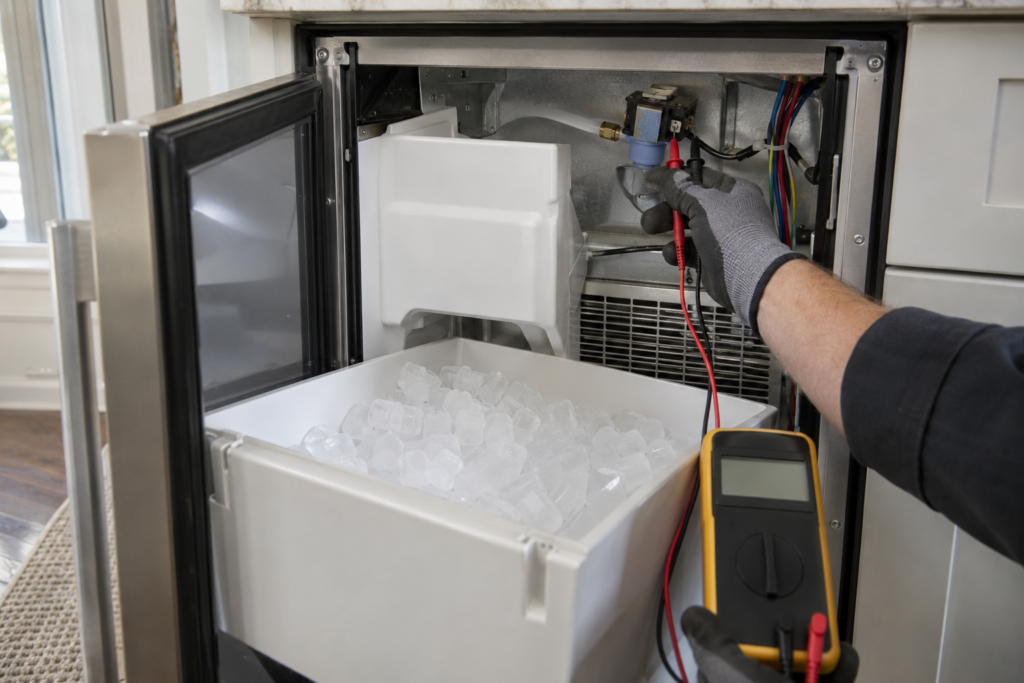
The diagnostic buys an answer rather than a guess. On the UC-15I and UC-15IP, the service page describes a visit that retrieves the fault codes, runs a full harvest cycle test and inspects the water system, and after the repair the technician runs a full cleaning cycle and verifies ice production.
- Codes retrieved and compared with the symptom you describe, so that a slow-ice complaint is not treated as a valve fault by default.
- A harvest cycle test, which separates a water problem from a freezing or release problem.
- A water path inspection of the supply, the inlet screen, the valve and the drain, where most owner-level causes live.
Because those steps come first, the estimate that follows is for one named part, with the labor listed separately, rather than for a vague "ice maker repair."
What Sets the Price of an Ice Maker Visit?
Three things set the price: which group of parts failed, how much of the cabinet has to come apart to reach them, and whether the machine is still the right one to keep. The first is a diagnosis question and the other two are installation questions.
- The failing part group. A valve or sensor sits at the low end; a harvest motor, hot-gas path or evaporator sits higher because it involves more labor and more specialized parts.
- Access. An undercounter unit usually has to be slid out of its opening, which depends on the water line, the drain and the cabinet around it.
- Water quality. Heavy scale turns a quick valve swap into a descaling job as well, since a new valve on a scaled circuit fails sooner.
- Model and age. The unit is rated for 23 lbs of ice per day under standard conditions, and an older machine with several worn parts changes the repair-or-replace arithmetic.
The diagnostic is the one fixed figure. It runs the harvest cycle, reads the codes and inspects the water path, so the estimate that follows is for a named part and not a guess.
Which Ice Maker Symptoms Cost Less to Fix?
The cheapest outcomes are the ones with an owner-level cause, and several of them cost nothing at all. This site's code pages separate those from the ones that need a technician, which is the best predictor of the invoice.
- SLOW-ICE is usually heat or water first. The SLOW-ICE page describes a clear front grille, an open shutoff valve and normal supply pressure as the free checks, and it says service is worth booking only when output stays below 12 lbs per day in a well-ventilated installation.
- HARV-STUCK can clear on its own. The HARV-STUCK page advises letting the stuck ice melt with the door open for 20 to 30 minutes, drying the evaporator and restarting; a repeat within a week is the signal to pay for a diagnosis.
- EC30 sits in the middle. The EC30 page lists a blocked inlet screen and low pressure as owner-level causes, and a failed solenoid as the technician cause.
- WATER-LEAK is the one not to price by guesswork, because the source decides everything. A loose supply fitting is cheap; a cracked reservoir or a leak inside the cabinet is not.
If the symptom is simply less ice than before, start with our guide to a Sub-Zero ice maker not making ice before paying for a visit.
Is the Repair Worth Paying For?
Usually yes for valve, sensor and cleaning work, and it is worth a pause for anything involving the sealed system. The point of the decision is how much of the machine's remaining life the money buys, not the invoice alone.
Some cases lean clearly towards repair:
- A first failure of a single part on a machine that has otherwise run well for years.
- A cleaning-related fault that returns the machine to its rated output once the circuit is descaled.
- A supply or drain fitting that is cheap to replace and not a symptom of something deeper.
Other cases deserve a second thought:
- Repeated visits for different parts within a couple of years, which suggests a tired machine.
- Harvest and sealed-system work on a unit more than about a decade old, where a written estimate should be compared with the price of a new unit.
The full framework is in our ice maker repair-or-replace guide and the is-it-worth-repairing overview, which both treat the whole appliance. A valve-specific decision lives in the EC30 valve guide.
One more point on value: the work is cheaper when the machine is caught early. A unit that has been making thin ice for a month is a valve job; the same unit left for a year can add scale on the evaporator and a stressed motor. If the symptom is changing from week to week, book sooner rather than later.
How to Keep the Bill Down
You keep it down by giving the technician a clean story and by preventing the scale that turns small jobs into big ones. Three habits do most of the work.
- Do the free checks first, in the order the code page lists them, and keep a one-line log of the date, the room temperature and how full the bin was after 24 hours.
- Replace the water filter on schedule. An expired filter restricts flow, which is the same condition that stresses an inlet valve; the water filter replacement guide has the interval.
- Run the cleaning cycle when asked. The CLEANING-DUE guide explains why scale slows the machine and shortens the life of its valve.
What Should a Written Estimate Include?
A written estimate should name the part, the labor and any cleaning step separately, so you can compare it with another quote. On this site every repair is confirmed after an on-site diagnosis, and the estimate is written before any work begins; no price is final until then.
Ask for the model number on the estimate, since parts are matched to the UC-15I or UC-15IP, and ask whether the cleaning cycle and a harvest test are included. When you are ready, schedule a diagnostic and describe the symptom, the code if there is one, and what you already tried. For anything in the cabinet that is not ice-related, the contact page reaches us as well.