 Daniel York
Key Takeaways
- The Sub-Zero ice maker CLEANING-DUE alert is logged as Periodic Cleaning Overdue — a scheduled reminder, not a fault.
- Mineral and biofilm buildup left unaddressed eventually causes the harvest problems this site logs as separate faults.
- Most households need the cleaning cycle roughly every six months; hard-water households often need it closer to four.
- An owner-run cleaning cycle handles the water lines but not the harvest assembly, which needs a professional clean about once a year.
- An alert that keeps returning faster than every few months usually points at water quality, not the machine.
The Bottom Line
The CLEANING-DUE alert is the ice maker asking for routine maintenance before mineral buildup turns into a harvest problem. Run the owner cycle when it appears, and schedule a professional clean of the harvest assembly about once a year regardless.
A Sub-Zero ice maker CLEANING-DUE alert is not a malfunction — it is the machine keeping its own maintenance schedule, and ignoring it is what eventually turns into a real repair call. This site logs the alert plainly, and the cleaning it is asking for takes less time than most owners assume.
| Signal | What it means | What to do | How often |
|---|---|---|---|
| CLEANING-DUE alert | Periodic Cleaning Overdue | Run the built-in cleaning cycle or schedule a professional clean | Roughly every 6 months for most households |
| No alert, but ice tastes off | Mineral or biofilm buildup ahead of the alert threshold | Clean early rather than waiting for the alert | As noticed |
| Alert clears, then returns quickly | Water quality or filter issue driving faster buildup | Check filter age and local water hardness | Investigate at the next clean |
What Does the Sub-Zero Ice Maker CLEANING-DUE Alert Mean?
It means the ice maker's internal counter has reached the point where mineral and biofilm buildup is expected to start affecting ice quality and production, whether or not you have noticed anything yet. This site logs CLEANING-DUE as Periodic Cleaning Overdue — a scheduled reminder, not a fault code, and the distinction matters because nothing about the machine has failed yet when it first appears.
Why a Cleaning Reminder Deserves Real Attention
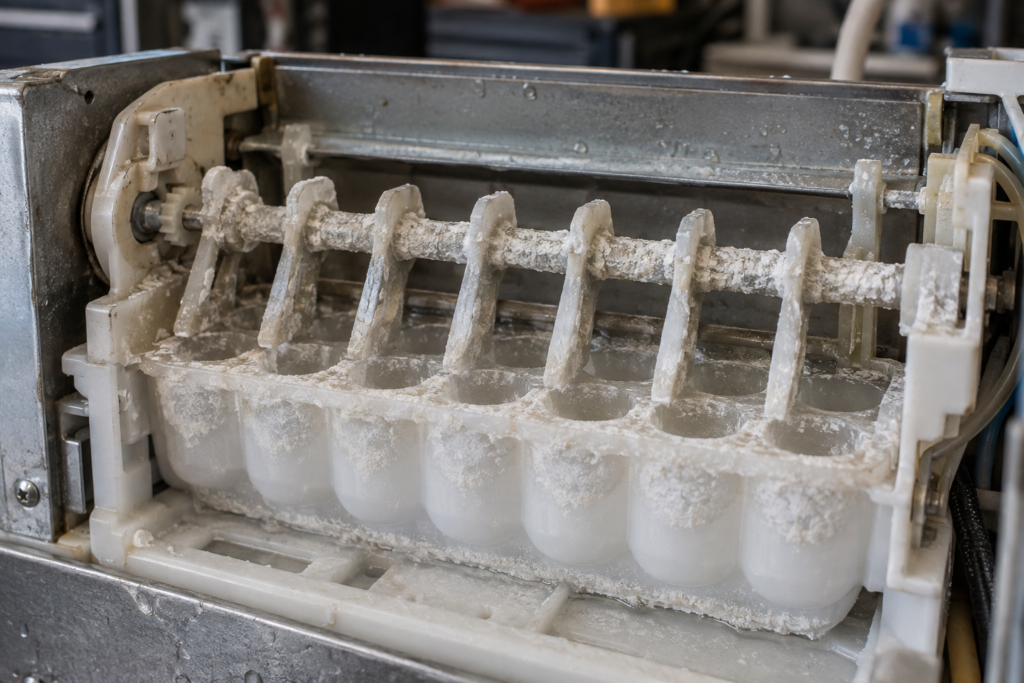
An ice maker moves water over the same surfaces hundreds of times a week, and every pass leaves behind a trace of whatever minerals were in that water. Left alone, that trace becomes a coating — first on the harvest surface, then in the water lines feeding it. A coated surface releases ice less cleanly, which is what eventually shows up as the harvest problems this site logs separately.
- Ice production slows gradually as mineral buildup insulates the freezing surface from the refrigerant behind it.
- Ice quality changes — cloudier cubes, or a faint mineral taste, are early signs that predate any alert.
- Harvest problems follow if cleaning is deferred long enough; a heavily scaled surface releases ice unevenly or not at all.
- Water lines narrow over time in hard-water households, which is a separate but related consequence of the same buildup.
Is Every Six Months Really Necessary?
For most households, yes, though it depends heavily on your water hardness and how much the ice maker runs. Households on well water or in hard-water regions often need the cycle closer to every four months, while a household with a whole-house softener and moderate ice use can sometimes stretch it. This site's own alert threshold is the more reliable signal than a calendar guess, and if the alert is repeating faster than every four to five months, that pattern itself is worth mentioning at your next service — it usually points at water quality rather than the machine.
Can You Clear a CLEANING-DUE Alert Yourself?
Partly. Most Sub-Zero ice makers include a built-in cleaning cycle that flushes the internal lines with a cleaning solution and resets the counter, and running that cycle is well within an owner's reach when the appliance manual describes the steps for your specific model. What an owner-run cycle does not reach is the harvest assembly itself, which needs to come apart for a thorough clean roughly once a year even on units run on soft water.
- Locate your model's cleaning cycle in the control panel menu — it is usually under a maintenance or diagnostics submenu.
- Use the cleaning solution specified for your model, not a generic descaling product, since the wrong chemistry can damage food-contact plastics.
- Run the full cycle without interruption; stopping partway can leave solution in the lines.
- Discard the first batch or two of ice produced after the cycle completes.
- Schedule a professional clean annually even if you run the owner cycle more often, to reach the harvest assembly.
Our Sub-Zero maintenance schedule sets out where ice maker cleaning fits alongside condenser and filter care for the rest of the unit.
When to Call Instead of Clean It Yourself
If the alert keeps returning faster than every few months, if ice production has already slowed noticeably, or if you notice the harvest problems described in our guide to Sub-Zero outdoor ice maker repair, a professional clean and inspection is the better move than another owner-run cycle. A professional cleaning service starts from $150 and reaches the harvest assembly the owner cycle cannot. When you are ready, schedule a visit and mention how many times the alert has already cleared and returned.
Does Your Water Filter Change the Interval?
Yes, directly. A Sub-Zero water filter is what catches most of the sediment and a meaningful share of the dissolved minerals before they ever reach the ice maker, and a filter running past its rated life stops doing that job long before it stops producing water at all. If your CLEANING-DUE alerts have been arriving noticeably closer together than they used to, check the filter change date before assuming the ice maker itself is aging badly.
Our guide to Sub-Zero water filter replacement sets out the standard interval and the signs a filter is overdue. Households in genuinely hard-water areas sometimes need a whole-house softener or a dedicated inline filter ahead of the refrigerator's own filter to keep the standard cleaning interval realistic — a plumber, not the appliance, is usually the answer at that point.
- Replace the water filter on schedule, independent of the ice maker's own cleaning cycle.
- Track filter changes and cleaning cycles together so a shortening interval on one points you toward the right cause.
- Consider your local water hardness honestly before assuming the appliance is under-performing.
What a Cleaning Cycle Will Not Fix
A cleaning cycle addresses mineral and biofilm buildup — it does not address a mechanical fault, and it is worth knowing the difference before you run the cycle repeatedly hoping it clears something else. If ice production has stopped rather than merely slowed, if you hear the harvest motor straining without producing ice, or if water is pooling under or behind the unit, those are separate faults with their own codes on this site, not symptoms a cleaning cycle will resolve.
- Run the cleaning cycle once when the alert appears, and give it a few production cycles to show a result.
- If production has not improved after two full cycles, treat it as a separate fault rather than a cleaning problem.
- Do not run the cleaning cycle repeatedly as a substitute for diagnosing a harvest or water-supply fault.
Our guide to Sub-Zero ice maker not making ice covers the harvest and water-supply faults this cleaning cycle cannot reach, and is the better next read if the cycle has run twice with no change in production, since it walks through the harvest motor, the water supply and the sensors that a cleaning cycle cannot touch.