 Daniel York
Key Takeaways
- Wipe the gasket regularly and run the banknote test every six months; that single habit prevents most seal failures.
- Clean the condenser every 12 to 24 months on built-in units and every 6 to 12 on freestanding ones.
- A smooth sheet of ice on the back wall is a defrost warning, and chipping it can puncture soft aluminum tubing.
- Set the high-temperature alarm 10 degrees F above the set point and test it once.
- A professional inspection every two to three years covers fan bearings, refrigerant charge and the defrost circuit.
The Bottom Line
Freezer maintenance is a seal, a coil, a wall and an alarm. Do the monthly look, the six-month tests and the coil job on schedule, and book a visit when frost returns within two days.
A freezer column is the part of a Sub-Zero kitchen that nobody looks at until something thaws, which is exactly why a short routine pays off. Four jobs cover Sub-Zero freezer maintenance: protect the seal, keep heat rejection clear, watch the defrost system and set the alarm. All four fit into an afternoon twice a year. The schedule below follows this site's complete maintenance schedule, narrowed to what a freezer needs.
| Task | How often | What it prevents |
|---|---|---|
| Wipe the door gasket and look at its profile | Whenever it looks dirty, and at each seal check | Hardening, mold and a seal that slowly stops sealing |
| Banknote test on all four sides | Every 6 months | Warm air leaking in unnoticed |
| Check the freezer reads 0 degrees F or below | Every 6 months | Slow drift that you only meet as softened food |
| Clean the condenser coil | 12 to 24 months for built-in units, 6 to 12 for freestanding | Compressor overheating and fan strain |
| Look at the back wall for frost | Monthly | An unseen defrost fault |
| Test the temperature alarm | After setting it, then yearly | Finding out about a failure too late |
How Often Should You Do Sub-Zero Freezer Maintenance?
Twice a year for the seal and the temperature, once every one to two years for the condenser, and a thirty-second look every month. That rhythm is the one in this site's schedule, and it takes roughly fifteen minutes a month plus one longer session each spring and fall.
A professional preventive inspection every two to three years adds the things an owner cannot safely do: checking fan bearings, the refrigerant charge and the defrost circuit. If the unit is older than ten years, shorten that interval. You can see what a visit covers on the preventive maintenance service page.
What Should You Check Each Month?
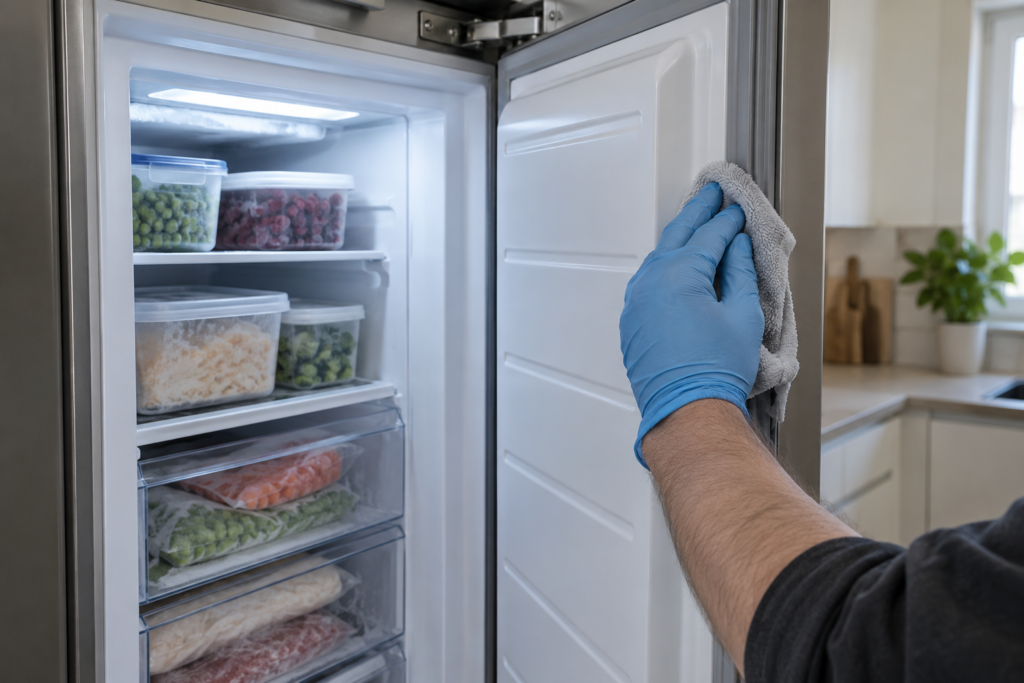
You should check the inside back wall, the door edge and the sound of the unit, in that order. These three give the earliest warning of the faults the site lists most often for freezers.
- The back wall. Light frost is normal; a smooth sheet of ice or a layer that gets thicker week by week means the defrost cycle is not finishing. The freezer defrost problems guide and the EC 24 guide describe what that looks like.
- The door edge. Wipe any residue with warm water and mild soap. A sticky gasket drags and tears when the door opens, and a dry, stiff one stops gripping.
- The sound. A compressor that seems to run all day, or clicks and a faint hiss from behind the rear panel during defrost, are worth a note with the date.
- The contents. Packages jammed against the back wall block airflow, so leave a small gap behind and above the stored food.
Never chip ice from the evaporator or the back wall. The tubing is soft aluminum, and a puncture turns a heater job into a sealed system job. If frost is already thick, a manual defrost with the breaker off is the safe way to clear it, and the code pages describe exactly how.
What Changes for an Older Freezer?
Everything on the list gets a little more frequent, because an older gasket stiffens and an older compressor has less margin. If the column is more than ten years old, do the banknote test more often than every six months, and treat a gasket that is cracked or flat as a part to replace on your own schedule, not after it fails.
- Interior cleaning every month, about 10 to 15 minutes, because spills near a sensor can disturb its readings.
- A condenser job every year, especially in a kitchen with a lot of cooking dust or pets.
- A professional visit before it is needed, so that a bearing or charge issue is found while it is still small.
Interior cleaning belongs in the same rhythm. A quick monthly wipe of shelves and the door edge keeps spills away from sensors and gasket folds, and it gives you the monthly look at the back wall for free.
Condenser and Seal: The Two Jobs That Matter Most
Condenser cleaning and the seal test are the highest-impact tasks on the list. A fouled condenser makes the compressor work harder, and a leaking door gives it more work to do; together they produce the long run times that precede most freezer failures.
- Switch off the unit and remove the base grille following your model's manual.
- Vacuum the coil and the fan area with a soft brush attachment, working with the fins, never across them.
- Clear the space in front of the grille. Most Sub-Zero built-in models reject heat through the front grille, so nothing should be stored against it.
- Close the door on a banknote at the top, bottom, hinge side and latch side, and note any spot where it slides out.
- Restore power and confirm the compressor starts.
The step-by-step version is in our condenser coil cleaning guide, and the gasket routine is in the door gasket care guide.
How Do You Set Up the Temperature Alarm on a Freezer Column?
You set it from the control panel by following the settings procedure in your owner's manual, and the site's temperature alarm setup notice recommends a high-temperature threshold of 10 degrees Fahrenheit above the set point. For a freezer held at 0, that means an alarm at 10.
- Enable the high-temperature alarm and set the threshold as above.
- Enable the door-ajar alarm if your model has one; the notice says it triggers after the door has been open for 60 seconds.
- Test it by briefly warming the sensor area with a warm cloth and confirming the audible and visual alert.
- Make sure you can hear it, or connect it to a notification system if your model supports one.
Many owners never configure this on installation. It costs nothing and turns a failure that would have been found at breakfast into one found within the hour. If the alarm sounds repeatedly with no open door or power outage, that points to a refrigerant, compressor or thermostat issue and deserves a diagnostic.
Power and Defrost Habits That Help
Good power and good defrost habits protect the electronics and the evaporator. After any storm or outage, check for error codes before going back to normal use; the surge protector notice explains why a voltage spike can damage the control board.
If a defrost fault does appear, a manual defrost only buys time. The EC20 page describes switching the breaker off for about eight hours with the door propped open and a towel on the floor, and it states plainly that the code returns at the next defrost cycle unless the fault is repaired.
When to Call for Service
Call when frost returns within 48 hours of a manual defrost, when the freezer will not hold 0 degrees after a clean condenser and a good seal, or when a code returns after a reset. Keep notes on the date, the reading and what you did; they shorten the visit.
Our freezer repair page lists the faults a technician handles, including thermistors, the defrost heater and the evaporator fan. When a task on this list is beyond you, schedule a visit and ask for the seal, the coil and the defrost circuit to be checked together.