 Daniel York
Key Takeaways
- A worn door seal usually shows as a repeating door alert, moisture or frost along the edge, and a cabinet that runs longer than before.
- The banknote test on all four sides tells a hinge or shelf problem from worn rubber; clean the gasket first.
- Ambient heat, condenser dust and sensor drift can mimic a bad seal, so check them before ordering a part.
- The cabinet is not unsafe with a worn seal, but move fine bottles if the shelf passes 65 degrees Fahrenheit or corks dry out.
- Never glue a torn gasket; a model-specific replacement is the lasting fix.
The Bottom Line
Test the seal before blaming the compressor or the humidity system. If the bill slides out at any point after cleaning, plan a gasket or hinge visit and write down where it failed.
A wine cabinet only protects a collection while its door closes evenly on every side. When the rubber edge softens, flattens or lifts away from the frame, warm room air starts leaking in, the compressor runs longer, and the first thing most owners notice is a chime or a drifting display rather than a visible gap. A worn Sub-Zero wine cooler door seal is usually found by touch and by a simple paper test, not by looking at it, and the same wear is what trips the DOOR-AJAR alert described on this site's DOOR-AJAR code page.
| What you notice | What it usually points to | First move |
|---|---|---|
| Chime repeats although the door looks shut | Gasket no longer presses the door switch evenly, or a hinge has shifted | Run the bill test on all four sides |
| Thin line of moisture or frost along the door edge | An uneven seal letting humid room air reach a cold surface | Wipe the gasket and inspect it for a flat spot |
| Bottles feel warmer than the setpoint | Seal leak, condenser dust or sensor drift | Put an independent thermometer on a middle shelf |
| Corks dry or labels damp | Humidity outside the wine-safe band because room air exchanges freely | Check the seal before blaming any humidity part |
| Door swings back slightly after you close it | Misaligned hinge or an obstruction on the shelf | Clear the front rail and look for a crooked door edge |
How Do You Know a Sub-Zero Wine Cooler Door Seal Is Failing?
You know it by a pattern, not by one symptom: a seal that has lost compression shows up as a chime, a faint line of moisture or frost where the door meets the cabinet, and a cabinet that runs more often than it used to. Any one of these can have another cause, but two together point at the door edge.
- A recurring door alert that returns even after you push the door firmly shut. This site's DOOR-AJAR page explains that the door switch is not fully pressed because the gasket has softened and flattened.
- Moisture or frost along the perimeter, usually first at the top corner on the hinge side where the door sags most.
- Longer run times. If the compressor seems to run more than it did last year, warm air is being pulled in faster than the cooling can remove it.
- A visible flat spot or crack where the rounded profile of the rubber has been squeezed permanently thin.
The cabinet is not unsafe while this happens, but the page rates the unit as "maybe" safe to keep using because wine ages faster at a slightly warm temperature. Avoid opening the door more than necessary until the seal is dealt with.
Can You Test the Seal Yourself?
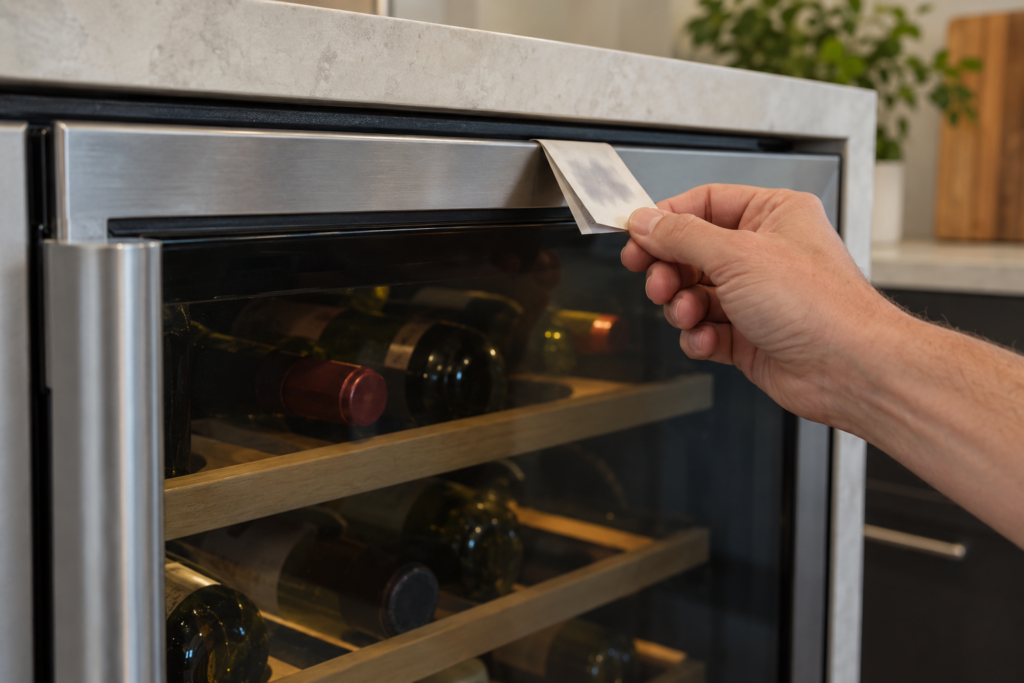
Yes, with a banknote and about five minutes. The same dollar-bill test appears on the site's door gasket inspection notice: you close the door on the bill and see how much it resists when you pull.
- Clean the gasket first with warm water and a drop of mild dish soap. A dirty gasket can mimic a failing one, and a film of residue stops the rubber from gripping.
- Fold a bill and place it flat on the seal at the top of the door, then close the door normally.
- Pull the bill out slowly. A healthy seal grips it and you feel firm resistance. A bill that slides out freely marks a leak at that spot.
- Repeat on all four sides and at the corners, not only at the handle, because wear is rarely even.
- Note where it fails. Failing on one side usually means a hinge or a shelf obstruction; failing in several places means the rubber itself is spent.
Write the failing positions down, with the date. A technician can use that map to tell a hinge adjustment from a full replacement, and the result is more useful than a general description such as "the door does not seal well."
Where the leak is tells you what to do next. A leak at the hinge side with a straight, undamaged gasket usually means the door has shifted and needs alignment, while leaks spread around the whole perimeter, or at the corners, mean the rubber has compressed and replacement is the lasting answer. Either way the cabinet itself is fine; it is the door edge that needs attention.
What Else Looks Like a Bad Seal
Several alerts on a wine cabinet look like door trouble and are not. Check these before ordering any part, because a new gasket will not fix a different fault.
- Ambient heat. The EC10 page notes that a room outside the 60 to 90 degree Fahrenheit operating range, or direct sun on the cabinet face, can raise the upper zone without any fault in the unit.
- Condenser dust. Slow drift over weeks, with the compressor sounding normal, is more often a fouled condenser than a leaking door.
- Sensor drift. On older Classic BW-series cabinets the site describes a temperature sensor that reads colder than the real shelf temperature, which is why an independent thermometer is worth the few dollars.
- An obstruction. A bottle neck or shelf rail sitting proud of the cabinet keeps the door from closing evenly and mimics a worn gasket exactly.
The humidity side has its own page. If corks are drying or labels are damp, read the HUMIDITY-ALERT page and our guide to wine storage humidity maintenance, which treats the door seal as the first suspect and the humidification membrane as the second.
Is It Safe to Keep Wine in the Cabinet With a Worn Seal?
For a short time, yes, if the temperature stays near the setpoint and the corks look normal. The site's own guidance is that a door which is not sealing warms the cabinet and raises energy use, but does not make the unit unsafe.
Move fine bottles somewhere stable if any of these appear:
- Cabinet temperature above 65 degrees Fahrenheit even with the door apparently closed.
- A gap you can see between the door and the frame.
- Corks that feel hard, crumbly or damp, or any mold on labels or shelves.
Do not try to glue or patch a torn gasket. A patch never restores the original compression and tends to shorten the time to a full replacement. Our door gasket care guide covers the cleaning routine that slows this wear, and the gasket replacement cost guide explains what a model-specific part involves.
When to Book Service
Book when the bill test fails after cleaning, when the door sits visibly crooked, or when the alert returns after you have cleared the front rail. Gasket parts are matched to the cabinet model, so have the full model number ready; the label location is covered in our model number guide.
A diagnostic visit for the wine refrigeration repair service starts from $145. The final price depends on the part and the labor and is confirmed after the on-site diagnosis, with a written estimate before any work begins. If you want a technician to run the seal test and check the hinges and the sensor in one visit, schedule a visit and mention which sides of the door failed the bill test.