 Daniel York
Key Takeaways
- A Sub-Zero condenser fan repair or replace decision is almost always a repair — the fan motor is inexpensive and quick to replace.
- A blocked condenser coil produces the same warm-running symptom as a failed fan, and both are checked together during a diagnostic.
- Pet hair and household dust cause most fan jams, which makes this largely a maintenance issue rather than a parts failure.
- A fan replacement starts from $220 and a coil clean-out from $150; a diagnostic to check both plus the compressor starts from $99.
- A fan down for weeks, not days, is what turns this from a small repair into a compressor repair-or-replace question.
The Bottom Line
Repair the condenser fan itself almost every time — it is inexpensive and the labor is straightforward. The only reason to think bigger is a fan that ran stalled for weeks and may have stressed the compressor.
Repair the fan — that is the short answer for almost every Sub-Zero condenser fan sitting warm or noisy in the base of the cabinet, and one of the cheapest calls you will make on the whole refrigeration system. The fan itself is a small, inexpensive part; what changes the picture is what caused it to fail and how long it ran that way before anyone noticed.
| Symptom | Likely cause | Repair or replace | Starting price |
|---|---|---|---|
| Fan not spinning, dusty blades | Debris jam or worn bearing | Repair — clean or replace the fan motor | from $220 |
| Fan spins, weak airflow | Blade damage or motor losing speed | Repair — replace the fan | from $220 |
| Fan fine, compressor runs hot regardless | Blocked condenser coil or grille | Repair — clean the assembly first | from $150 |
| Fan and compressor both stressed for months | Compressor strain from prolonged poor airflow | Compare repair against replacing the sealed system | Diagnose first |
What Does the Condenser Fan Actually Do?
The condenser fan pulls air across the condenser coil in the base of the unit, carrying away the heat the refrigerant just gave up so the compressor is not fighting its own exhaust. When that fan slows, jams or stops, the whole sealed system runs hotter and longer to hit the same setpoint — which is why a failed fan rarely stays a small problem if it goes unnoticed.
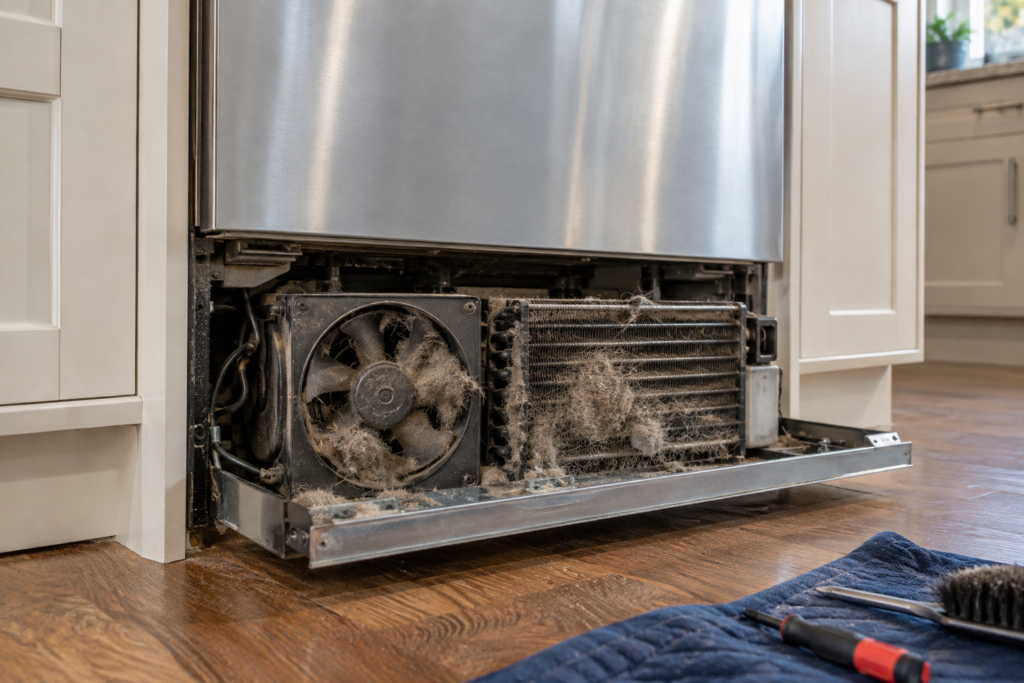
Sub-Zero Condenser Fan Repair or Replace: Which Is It?
Repair the fan itself almost every time — there is rarely a case for anything else at this level, since a fan motor is one of the least expensive moving parts in the whole cabinet. A condenser fan replacement starts from $220 and includes clearing the surrounding debris that likely contributed to the failure in the first place. The real decision is not about the fan; it is about what a stalled fan may have done to the compressor while it sat undetected.
- A fan caught within days of failing rarely affects the compressor at all — replace it and move on.
- A fan that stalled for weeks unnoticed puts sustained heat stress on the compressor, and that history is worth mentioning when you book service.
- Pet hair and household dust are the most common cause of a jammed fan, not a motor defect — this is a maintenance failure more often than a parts failure.
Coil Blockage vs a Failed Fan
Often, yes — a blocked condenser coil produces the same symptom of a warm-running unit even with a perfectly healthy fan, because the fan can only move air through a coil that is not caked shut. A coil clean-out starts from $150 and is worth doing before authorizing a fan replacement, since a technician diagnosing warm running on-site checks both together. Our guide to condenser coil cleaning covers how often that should happen on its own, independent of any fan fault.
When Does This Become a Bigger Repair?
If the fan has clearly been down for an extended stretch — weeks of a warm-running unit, or a compressor that has been cycling constantly to compensate — the conversation shifts from the fan to whatever load that put on the sealed system. That is the point where the decision stops being about a $220 part and starts looking like the broader question our guide to Sub-Zero compressor repair or replace is written for. A diagnostic visit that checks compressor health alongside the fan and coil starts from $99, and nothing beyond that figure is quoted until the technician has actually looked.
Most fan failures never reach that point. Caught within a reasonable window, a condenser fan replacement is a straightforward, inexpensive repair that restores normal running with no lasting effect on the rest of the system.
Keeping This From Happening Again
A condenser fan lives in the base of the unit, which is exactly where household dust, pet hair and dropped debris collect if the grille is never checked.
- Pull and vacuum the base grille every few months, more often in a household with pets.
- Keep the area under the unit clear of stored items that can block the intake.
- Listen for the fan directly occasionally — a healthy fan is a quiet, steady hum, not a rattle or a whine.
- Book a condenser clean at the same interval as your filter changes, so the two never get out of sync.
Condenser and sealed system service is covered under Sub-Zero refrigerator repair and appliance diagnostics. When you are ready, schedule a visit and mention how long the unit has been running warm, if it has.
Cabinet Type and Access: Refrigerator, Freezer or Built-in
Not for the fan itself, but it matters for access. A freestanding refrigerator or freezer usually has its condenser fan reachable by pulling the unit forward and removing a rear or base panel — a job that takes a technician a few minutes once the unit is out. A built-in dual-refrigeration cabinet, by contrast, has its condenser and fan assembly tucked into a base that shares space with cabinetry on both sides, which is why the same $220 fan replacement takes longer, and costs more toward the top of that range, on a flush-installed unit than on a freestanding one.
This is the same access difference our guide to Sub-Zero repair or replace discusses for the sealed system more broadly — a smaller part behind a harder-to-reach panel still adds up to real labor, even when the part itself is inexpensive.
- Freestanding units generally see the lower end of the fan replacement range.
- Built-in and column units see the higher end, purely from access time.
- Either way, the fan part itself is a small fraction of the total invoice.
Signs the Fan Has Been Down Longer Than You Think
A stalled condenser fan does not always announce itself with obvious warmth right away, especially in a lightly used cabinet. A few signs are worth checking specifically before you assume a recently noticed fan problem is a recent fan problem.
- Check the compressor's run pattern against what you remember as normal — near-constant running is the clearest sign of a system compensating for lost airflow.
- Feel the air coming from the base grille — noticeably hot air, rather than warm, suggests the fan has been down for a while.
- Ask whether food or bottles have been running warmer than usual over the past few weeks, not just today.
- Mention any of these signs to the technician up front, since they change whether the visit is a fan swap or a fuller sealed-system check.
None of these signs mean the repair has become bigger on their own — they simply tell the technician which questions to ask first, and a diagnostic that starts with the right question tends to end with the right part on the truck the first time.