 Daniel York
Key Takeaways
- Most no-ice calls on outdoor units resolve between the shutoff valve and the inlet rather than inside the machine.
- A supply line that freezes can split a fitting, and the damage often shows up as a leak only after the thaw.
- Slower production in hot weather is usually the unit working against ambient heat, not a fault — clear the grille first.
- Ice welded to the evaporator is logged here as HARV-STUCK, and prying at it damages the most expensive part in the cabinet.
- An outdoor unit is diagnosed as an installation: supply, line routing, grille, drain and clearance, not just the box.
The Bottom Line
Outdoors, check the water path and the grille before you suspect the machine. Ice frozen to the evaporator or a valve that will not close are the two symptoms where owner troubleshooting stops and the water gets shut off.
An outdoor-rated ice maker under a summer kitchen counter lives a life no indoor unit has to survive. It breathes hot air in July, it sits through freezing nights in January, and its water line runs somewhere it was never meant to be seen. Sub-Zero outdoor ice maker repair therefore starts in a different place than an indoor call: before anyone opens the machine, the question is what the weather has been doing to it.
| What you see | What it usually means outdoors | How this site logs the code | First move |
|---|---|---|---|
| No ice at all, machine running | Water supply frozen or shut off | NO-ICE — No Ice Produced | Trace the line to the shutoff |
| Production has slowed down | Ambient heat, starved grille, or scale | SLOW-ICE — Production Below Expected Rate | Clear the grille, then descale |
| Ice frozen onto the evaporator | Harvest cycle cannot release the slab | HARV-STUCK — Harvest Cycle Incomplete | Stop and book service |
| Water pooling under the cabinet | Drain blocked, or a fitting has moved | WATER-LEAK — Water Pooling Under Unit | Shut the water off at the valve |
| Valve cycling more than it should | Solenoid staying active too long | EC30 — Water Valve Solenoid Over-Active | Shut the water off, then book |
| Cloudy, soft or small cubes | Cleaning overdue in hard water | CLEANING-DUE — Periodic Cleaning Overdue | Run the cleaning procedure |
What Being Outdoors Changes
Three things, and all three are about the environment rather than the machine.
Ambient temperature is the first. An ice maker rejects heat into the air around it, and when that air is already hot the unit runs longer for less ice. An owner who reads that as a failure in August frequently has a machine that is working exactly as built, just against worse conditions than a kitchen ever presents.
Freezing is the second, and it is the one that does damage. A supply line that freezes does not merely stop the water; if it freezes hard enough it can split a fitting, and the split shows itself later as a leak when the thaw arrives. Anything outdoors that carries water needs either heat or a plan for winter.
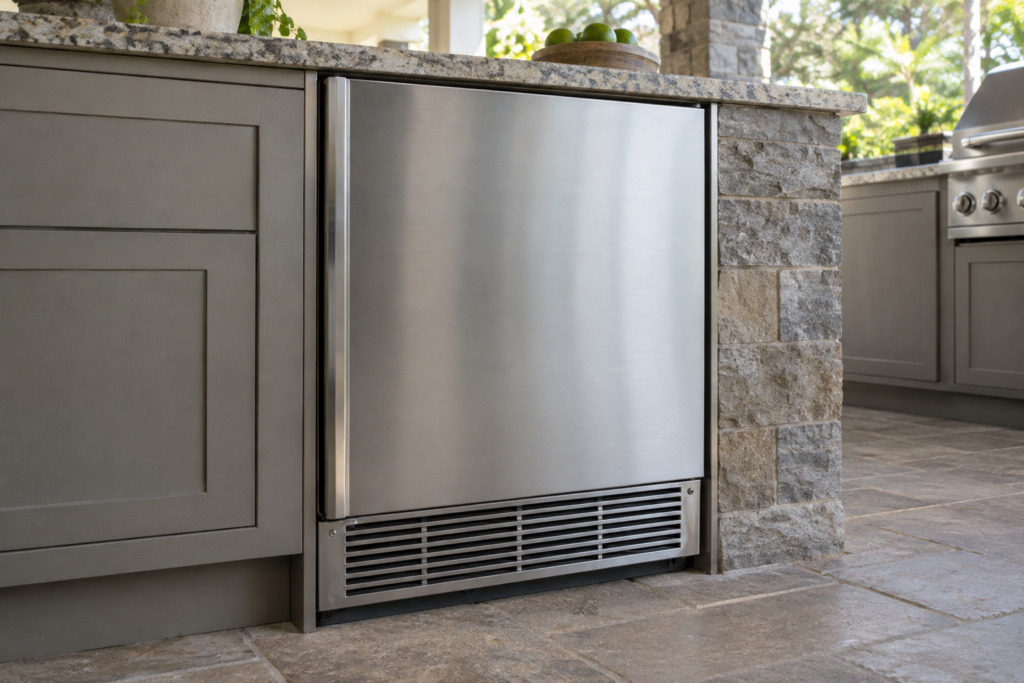
Airflow is the third. An outdoor cabinet's front grille is competing with leaves, planting debris, cooking grease from a grill three feet away, and whatever the wind brought. It clogs faster than any indoor grille, and the machine responds by making less ice.
Start on the Water Side
Most no-ice calls on outdoor units resolve somewhere between the shutoff valve and the inlet, not inside the machine. Work that path deliberately before assuming anything worse.
- Confirm the valve is actually open. Outdoor lines get shut off seasonally and then forgotten, which produces a machine that runs perfectly and makes nothing.
- Look for a frozen section. Any run of tubing through an unheated space, a crawl area or an exterior wall is the likely spot, not the run you can see.
- Check the filter. A filter left in service too long strangles flow, and the symptom is small hollow cubes rather than no cubes.
- Look underneath for water. Pooling means a blocked drain or a fitting that has moved, and this site logs that separately as a WATER-LEAK condition.
- Run the cleaning procedure. Outdoor units in hard-water regions scale up quickly, and scale shows up as slow production long before it shows up as a fault.
When Ice Will Not Release
The one symptom that should end owner troubleshooting is a slab of ice welded to the evaporator. This site records it as HARV-STUCK, Harvest Cycle Incomplete — Ice Frozen to Evaporator, and it is a genuine fault rather than a weather effect.
The reason to stop is mechanical. Harvest works by warming the evaporator just enough for the slab to let go and drop. When it does not let go, the machine keeps trying, and every attempt adds more ice to the problem. Prying at it is how evaporator plates get damaged and how a repair that was about a valve or a sensor becomes a repair about the coldest, most expensive part in the cabinet. Turn the unit off and leave it.
The valve code sits in the same family of restraint. EC30 is recorded here as Water Valve Solenoid Over-Active — a valve that is being asked to stay open longer than it should. Outdoors, with the unit built into cabinetry, that is a leak risk you do not want to sleep on. Shut the water off at the valve and book.
What a Service Visit Covers
An outdoor unit is diagnosed as an installation, not as a box. The technician checks supply pressure and temperature at the inlet, the condition and routing of the line, the grille and condenser, the harvest circuit, the drain path, and the way the cabinet was built in — because a unit with no clearance behind it will keep producing the same complaint whatever gets replaced.
Diagnostic visits start from $145 and cover that whole path. Final pricing is confirmed after the on-site diagnosis, with a written estimate before any work begins. What the visit includes is set out under Sub-Zero ice maker repair, and if the machine is indoors rather than out, our guide to an ice maker not making ice is the closer match.
Keeping an Outdoor Unit Alive
Outdoor ice makers reward a seasonal habit more than indoor ones do. Clear the grille when you clear the grill. Run the cleaning cycle on a schedule rather than when the cubes look wrong. And decide each autumn whether the unit runs through winter with its line protected, or comes out of service with the water off and the reservoir emptied — the failure mode is the half-measure where the machine is off and the line is still full.
If the unit is leaking, iced solid, or cycling its valve, schedule a visit and mention that it is an outdoor installation when you book. It changes what gets checked first.