 Daniel York
Key Takeaways
- A closed refrigerator section holds safe temperature for about four hours, a half-full freezer for about a day, and a packed freezer for about two.
- Every one of those windows assumes the doors stay shut — opening the freezer during an outage spends holding time you cannot get back.
- Dual refrigeration helps here: the food section warming up does not immediately drag the freezer section with it.
- Judge frozen food by ice crystals, not by appearance or smell; food that thawed and sat warm is not made safe by going back in the cold.
- Long run times and noise for several hours after power returns are recovery, not failure — but a code that stays is a service matter.
The Bottom Line
Keep the doors shut and a Sub-Zero gives you roughly four hours on the food side and up to two days in a full freezer. If the cabinet does not settle back to setpoint within a day of power returning, book the diagnostic rather than waiting it out.
The power goes out, and within about a minute somebody in the house asks the practical question: how long will a Sub-Zero fridge stay cold without power, and at what point does the food in it stop being food. It is a fair question with a real answer, and the answer depends far more on what you do in the first five minutes than on the cabinet's badge.
| Time without power | What is happening inside | What to do |
|---|---|---|
| First 4 hours | A closed refrigerator section holds safe temperature | Keep both doors shut. Do not check. |
| 4 hours and beyond | The food section is the first to leave the safe range | Plan to move perishables to a cooler |
| Up to 24 hours | A half-full freezer is still holding | Leave it alone; consolidate if you must open it |
| Up to 48 hours | A full freezer is still holding | Leave it alone; ice is doing the work |
| Past 48 hours | Thawing begins regardless of how full it is | Judge by ice crystals, not by smell |
| When power returns | Both circuits restart and run hard to recover | Watch for codes; do not reload immediately |
The Numbers That Actually Apply
A closed refrigerator compartment holds a safe temperature for roughly four hours. A freezer that is half full holds for around a day. A freezer that is packed holds for about two days. Those are the figures American food safety guidance uses for household refrigeration generally, and they apply here because the physics does, not because of anything specific to the brand.
Two details matter more than the averages. The first is how full the cabinet was when the power failed, because stored cold is stored in the food itself rather than in the air around it. The second is the room: a kitchen at seventy degrees drains a closed cabinet far more slowly than a kitchen that has also lost its air conditioning in the same storm.
What a well-built cabinet gives you is the better end of each of those windows rather than a different set of numbers. Thick insulation, tight gaskets and a flush installation all slow the rate of heat arrival. So does dual refrigeration: two sealed sections mean the food side warming up does not immediately drag the freezer side with it, which is exactly the separation you want during an outage.
The Only Rule That Matters
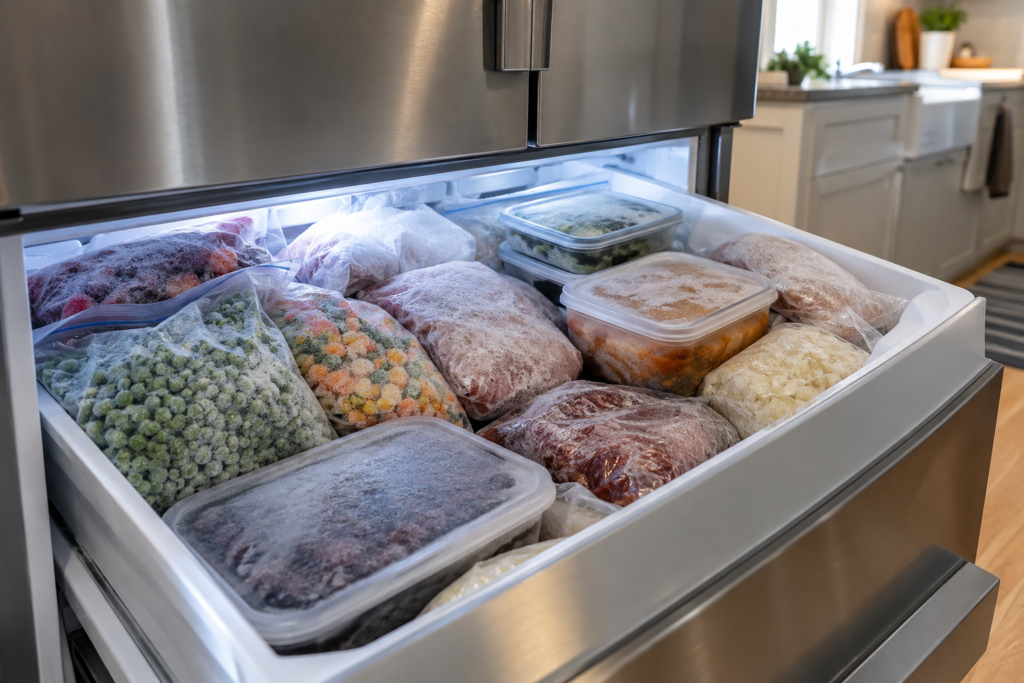
Every one of those windows assumes a door that stays shut. Open the freezer drawer once, and you have traded a measurable fraction of your remaining time for a look at food that has not changed since the last time you looked at it. Open it repeatedly and the two-day figure becomes a half-day figure.
- Decide before you open. If you need something, know what it is and where it is before the door moves.
- Consolidate once, not repeatedly. If you are moving food to a cooler, do it in one deliberate trip rather than five.
- Fill empty freezer space. Mass holds cold. Jugs of water frozen ahead of storm season are the cheapest insurance in the kitchen.
- Do not put a hot cooler's contents back. Food that has been out and rewarmed does not become safe again by going back into a cold cabinet.
- Leave the ice maker alone. A harvest cycle during an outage costs stored cold and gains you nothing.
Judging What Survived
The rule that keeps people safe is simple and unforgiving: judge frozen food by ice crystals, not by how it looks or smells. Food that still carries ice crystals, or that is still at freezer temperature, can be refrozen. Food that has fully thawed and sat above refrigerator temperature for more than a couple of hours goes out, and that includes items that appear and smell completely normal.
The refrigerator side is stricter still. Meat, poultry, fish, dairy, eggs, cut produce and leftovers that have been above the safe range for more than four hours are not worth the risk, whatever they look like. Our guide to food safety during a cooling failure goes through the categories in detail, and the same thresholds apply whether the cause was a storm or a fault.
What the Cabinet Does When Power Returns
Expect noise and expect long run times. Both circuits restart, both compressors run hard, and a cabinet that has been off for a day may take several hours to pull back down to setpoint. That is recovery, not failure, and it is not the moment to reload the freezer with warm groceries.
Two things are worth watching during the first day back. If the unit displays a compressor overrun code — this site records EC40 as Freezer Compressor Overrun — after the cabinet has had ample time to recover, the recovery is not finishing and something else is wrong. And if the outage was caused by a surge or the power came back in stages, the control board is the component most likely to have been hurt. Our guide to Sub-Zero electrical safety covers what that looks like.
Preparing for the Next Outage
Outage performance is mostly a maintenance story told in advance. A gasket that seals cleanly, a condenser that is not blanketed in dust and a freezer with mass in it are three separate hours of holding time you either have or do not have when the lights go off. None of them can be arranged after the fact.
If the cabinet does not recover normally once power is restored, or if it came back with a code and kept it, treat that as a service matter rather than an outage after-effect. Emergency repair covers cooling failures with food at stake, and you can schedule a visit with the outage timeline in hand. Diagnostic visits start from $145, with final pricing confirmed after the on-site diagnosis and a written estimate before any work begins.