 Daniel York
Key Takeaways
- A built-in wine column runs two independently controlled zones, so half the cabinet can fail while the other half holds setpoint perfectly.
- This site logs EC10 as an Upper Cabinet Warm Temperature Alarm and EC12 as the same complaint about the lower cabinet — a zone alarm, not a part verdict.
- Both zones drifting together is the picture that points at the sealed system, which this site records as EC15.
- The base grille is the column's only air path; cabinetry trim, dust or a rug across it warms both zones at once.
- Wine has enormous thermal mass — read the display twice a day for a day before concluding anything from the bottles.
The Bottom Line
One warm zone in a wine column points at airflow, the fan or the zone control, and the compressor is usually fine. Two zones drifting together is a different order of problem and should be diagnosed rather than watched.
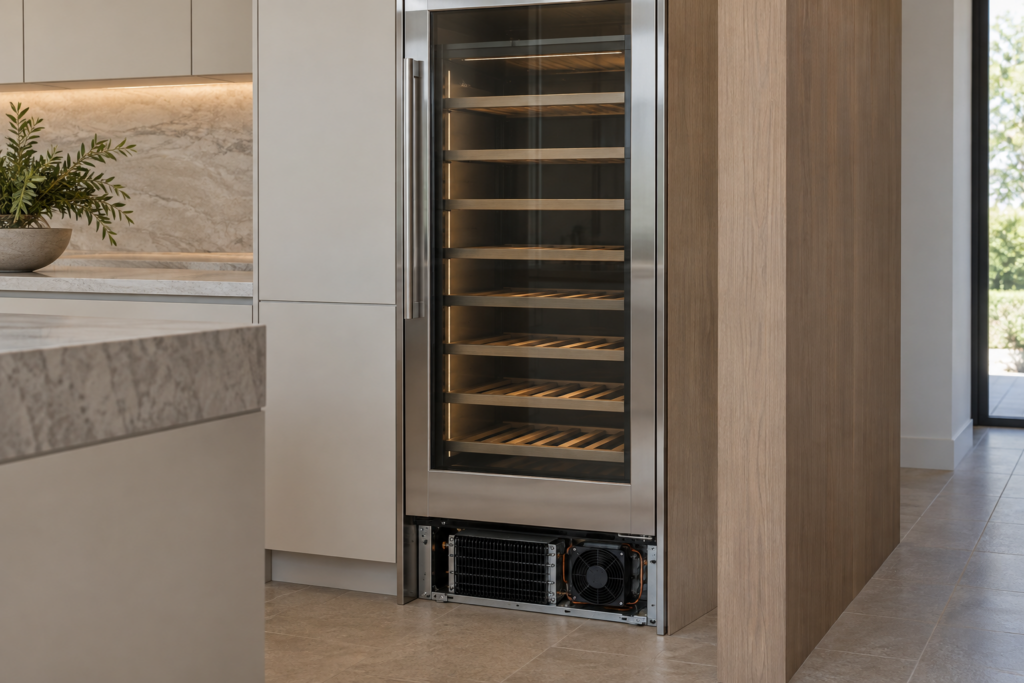
A built-in wine column is not a wine cooler with a taller door. It is a narrow column that fits flush into cabinetry, carries its own refrigeration in the base, and usually runs two independently controlled zones stacked one above the other. That architecture is why a column fails in ways a countertop unit never does, and why the first useful question is never "is it broken" but "which zone".
| What you see | Which part of the column | How this site logs it | Where to start |
|---|---|---|---|
| Top shelves warm, bottom holding | Upper zone control or damper | EC10 — Upper Cabinet Warm Temperature Alarm | Check the upper zone setpoint and airflow |
| Bottom shelves warm, top holding | Lower zone control or damper | EC12 — Lower Cabinet Warm Temperature Alarm | Check the lower zone and the base grille |
| Both zones drifting together | Refrigeration circuit | EC15 — Sealed System Fault | Stop and book a diagnostic |
| Clicking or whining from the base | Evaporator fan bearing | FAN-NOISE — Evaporator Fan Bearing Noise | Clear the grille, then have the fan checked |
| Condensation on the outside of the glass | Door glass and room humidity | GLASS-CONDENS — Condensation on Exterior Glass | Look at room humidity and door sealing |
| Part of the accent lighting dark | LED strip or driver | LIGHT-FAIL — Accent LED Strip Failed | Cosmetic; schedule with other work |
Why a Column Is Its Own Machine
Sub-Zero built-in wine column repair starts from three facts about the cabinet. It is tall and narrow, so the air that carries cold has a long way to travel and very little room to do it. It is flush-installed, so almost every service point is reached from the front, through the base. And it is dual zone, so half the cabinet can be perfectly fine while the other half is failing.
That last point is what most owners get wrong. If the bottles on the top two shelves are warm and the bottom of the column is at setpoint, the compressor is almost certainly working. What is not working is whatever decides how much cold air the upper zone receives. A system-wide failure produces a very different picture: both zones drift, and they drift together.
Reading the Zones Before You Read the Code
Give the column a day of honest observation before you conclude anything. Wine has enormous thermal mass, and a column full of bottles will hold its temperature for hours after the cooling has stopped, which means the display tells you the truth long before the bottles do.
- Write down both zone temperatures twice a day. Two readings apart in time say more than one reading now.
- Compare against setpoint, not against comfort. A zone deliberately set for reds is not failing because it reads warmer than the one set for whites.
- Watch the door habit. A column opened a dozen times an evening during a party will alarm and then recover; that is the cabinet behaving correctly.
- Listen at the base. Steady air movement is normal. Clicking, whining or a rhythmic rattle is a bearing complaint and gets logged separately.
- Check the grille. The base grille is the only air path the column has. Cabinetry trim, a rug, or a build-up of dust across the intake starves the condenser and warms both zones at once.
Only then look at the code. This site records EC10 as an Upper Cabinet Warm Temperature Alarm and EC12 as the same complaint about the lower cabinet — an alarm about a zone, not a verdict about a part. EC15 is logged as a Sealed System Fault, and that one is a different order of problem.
What Actually Fails in a Column
Ranked by how often it turns out to be the answer, the list is shorter than owners expect. Restricted airflow at the base grille comes first, and it is the one cause an owner can fix in an afternoon. Next comes the evaporator fan, which moves the cold air the zones share; when its bearing goes, one zone usually suffers before the other, and the noise arrives before the temperature does.
After that come the zone controls and dampers — the mechanism that decides which zone gets the air — and the door itself. A column door is heavy glass on a long hinge, and a hinge that has settled by a few millimeters will hold the seal open at one corner for years while looking perfectly closed. Humidity behavior is a related story, and our guide to wine storage humidity and vibration care covers what the cabinet is supposed to do.
The sealed system comes last, because it genuinely is last. A column that has lost refrigerant charge or has a failing compressor shows both zones drifting, long run times, and no recovery after the doors have been left alone.
Where the Owner's Work Ends
Clearing the grille, correcting setpoints, unloading a column that has been packed past its shelf capacity and confirming the door closes flush are all reasonable owner tasks, and they resolve a fair share of warm-zone alarms. Anything behind the base panel is not. The refrigeration circuit is sealed and pressurized, the fan assembly sits inside the air path, and the column has to come out of the cabinetry to reach most of it — with the door weight still attached.
A diagnostic visit on a wine column starts from $145 and covers both zones, the airflow path and the circuit rather than reading the alarm back to you. Final pricing is confirmed after the on-site diagnosis, with a written estimate before any work starts. The scope of a column visit is described under Sub-Zero wine column repair.
Protecting the Bottles While You Wait
A warm zone is not an emergency the way a warm freezer is, but it is not nothing either. Wine held above its intended range for days loses more than it does in an hour of heat, and repeated swings are worse than a single steady drift. Move the bottles you care about into the zone that is still holding, keep the doors shut, and leave the setpoints alone rather than chasing the display downward.
If both zones are drifting, treat it as time-critical and schedule a visit rather than waiting to see whether it settles. Tell us which zone alarmed, what both zones read, and whether anything has changed about the cabinetry or the room — that history is frequently the whole diagnosis.